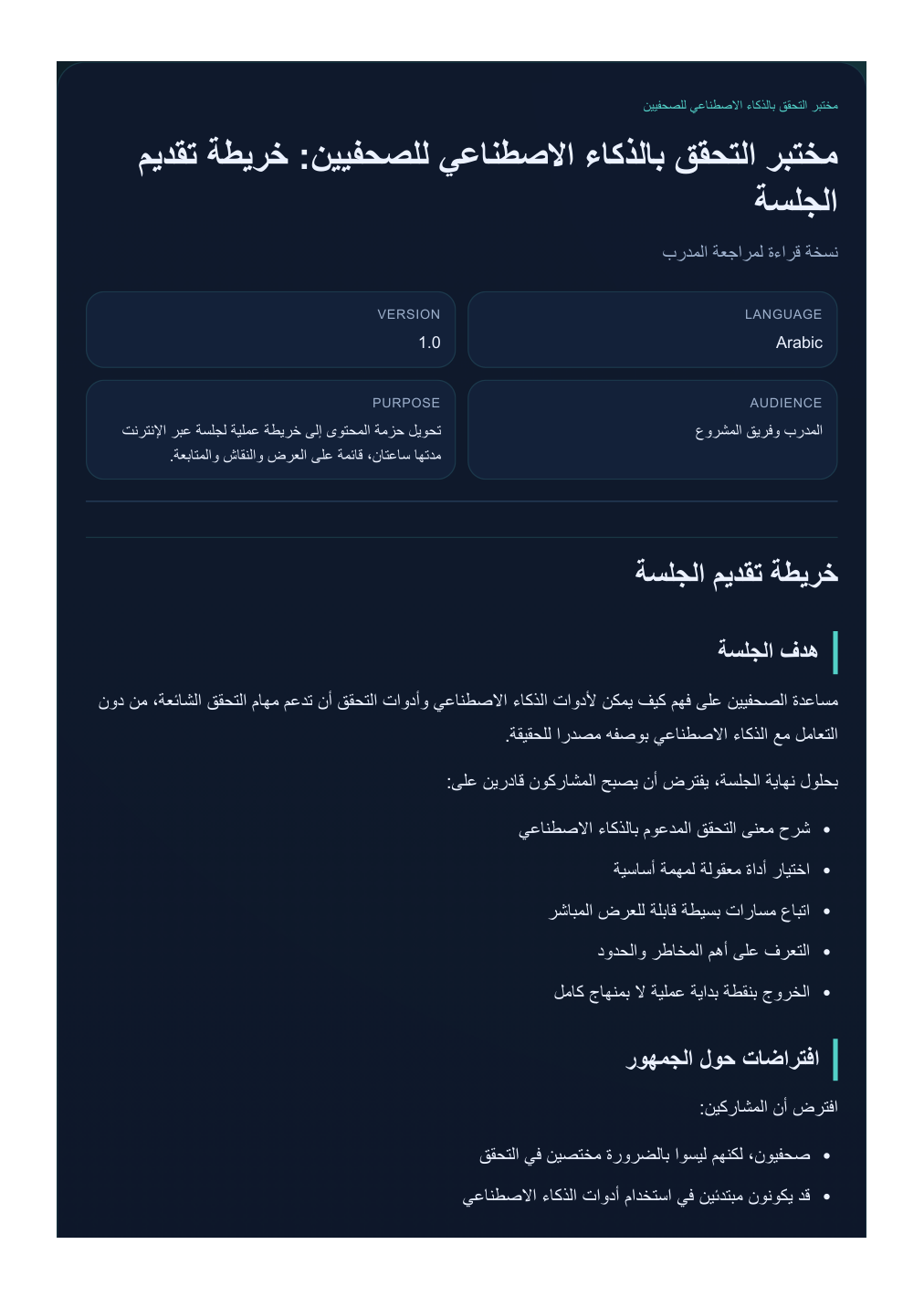
Source first Journalists with beginner-to-mixed AI experience
Session Core Guide
This guide explains why the session exists and what it promises: a practical understanding of AI-assisted verification without treating AI as a source.
- A simple definition of AI-assisted verification.
- A central message: AI is a thinking and workflow aid, not a final authority.
- A clear boundary around what the session covers and what it does not.
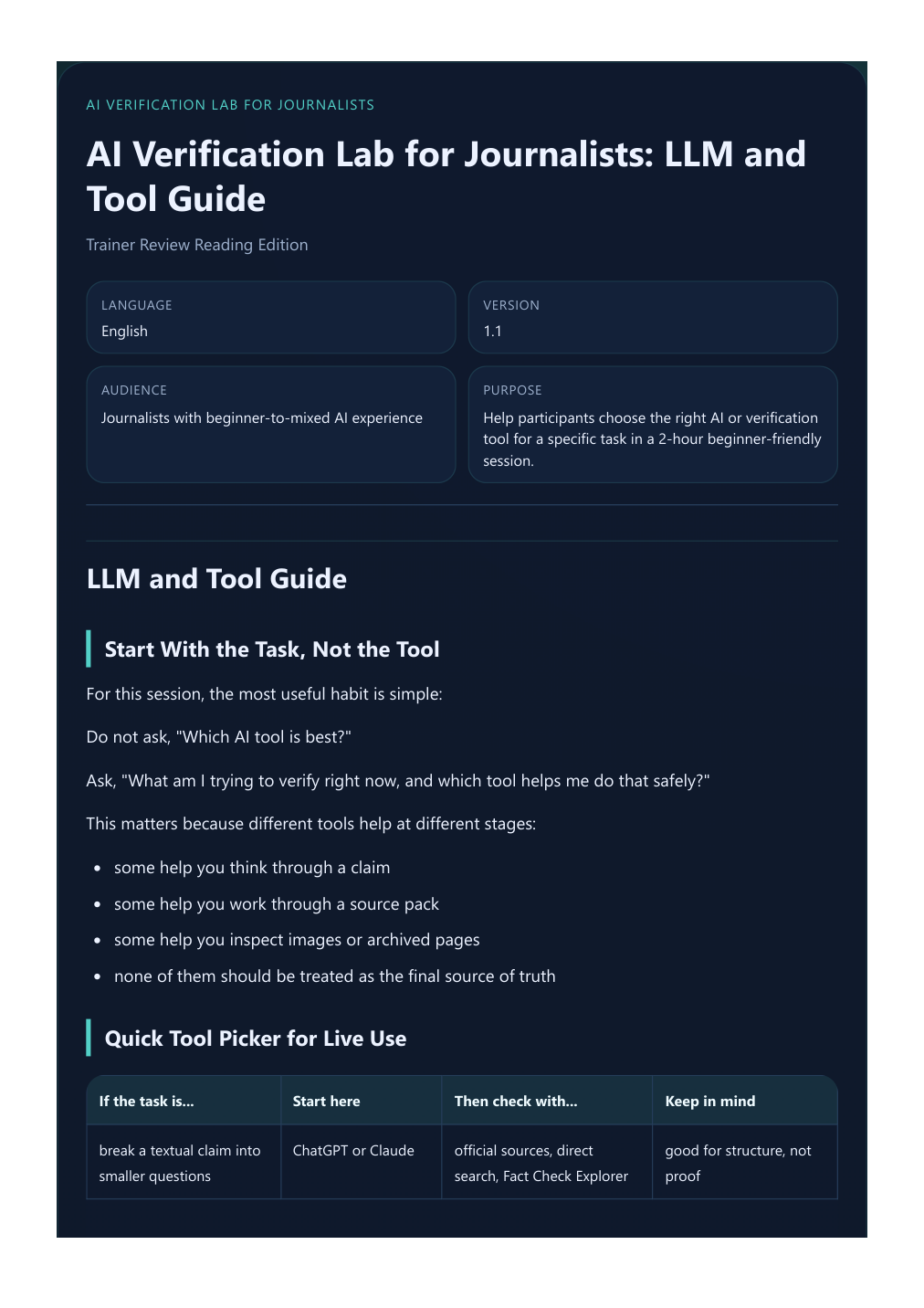
Source first Journalists who need a practical guide to tool choice
LLM and Tool Guide
This guide organizes tool choice around the task: breaking a claim down, reviewing documents, tracing an archived page, or supporting image and video checks.
- A quick picker for which tool to start with and what to verify manually after.
- Practical profiles for eight tools and models.
- A reminder that no tool should be trusted as the final truth on its own.
Source first Participants who need fast, clear working methods
Verification Workflows
Four short workflows for common cases: a textual claim, a suspicious image, a clip with unclear context, and a document set that needs structure and checking.
- Steps suitable for live demonstration or later reuse.
- A clear split between the role of AI and the role of the journalist.
- A suggested sequence from the simplest case to the most layered one.
Source first Trainers and participants who need realistic examples
Use Cases and Demo Scenarios
Practical, newsroom-adjacent scenarios that show how a journalist moves from a circulating claim toward a clearer, more responsible judgment.
- A breaking screenshot claim.
- A dramatic image said to be from today.
- A short clip with a strong caption, and a source pack that needs structure.
Source first All participants before they trust any output
Risks, Limits, and Good Practice
This guide is the safety valve: why a persuasive answer can still be weak, and how to protect the work from hallucination, source confusion, and false confidence.
- Seven core risks with a practical response for each.
- A short good-practice checklist.
- Memorable reminders for deadline pressure.
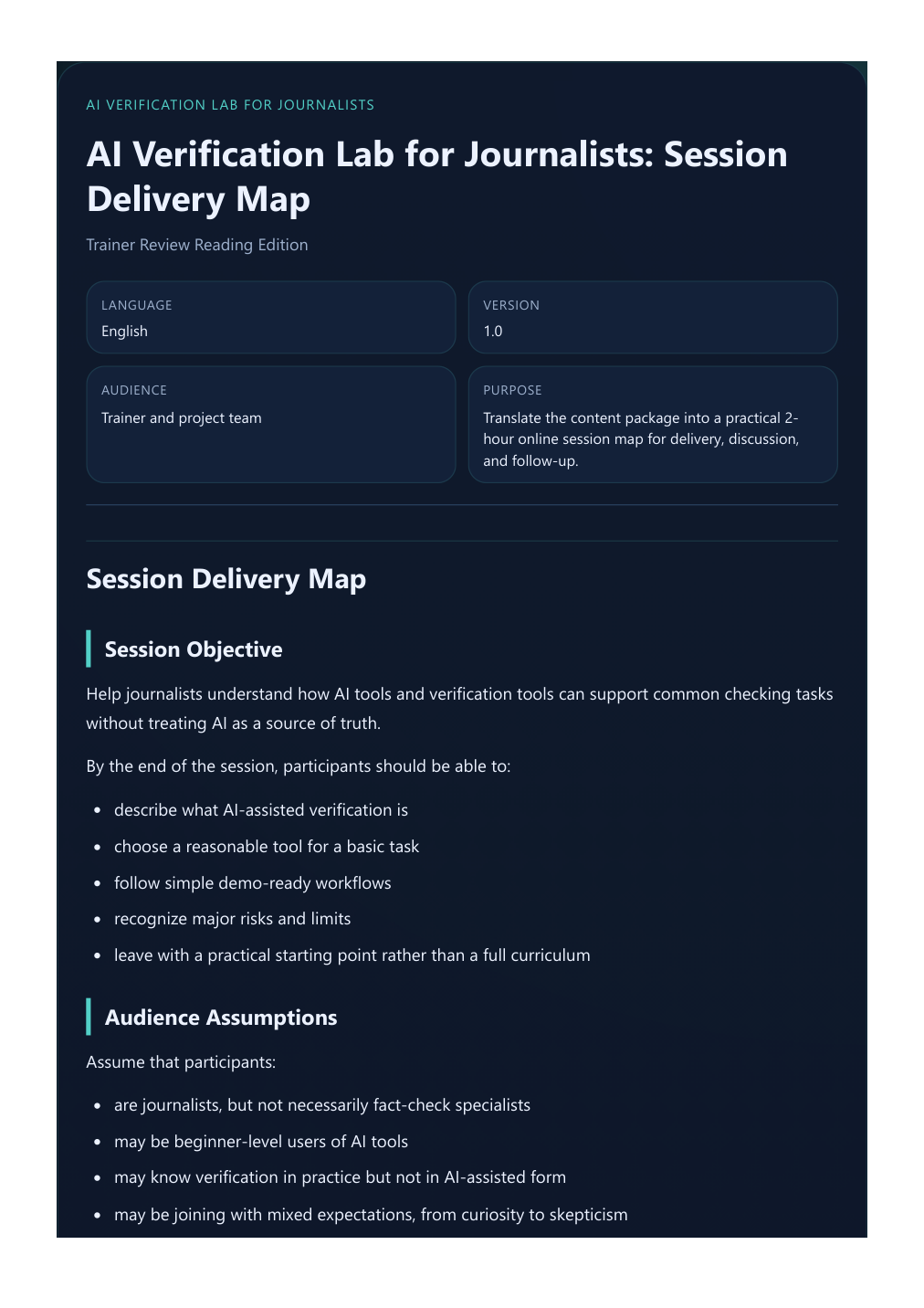
Source first Trainer and project team
Session Delivery Map
A practical map for sequencing the live session, pausing for discussion, and deciding what participants should receive afterward.
- A timing map for a two-hour session.
- A recommended order of live demonstrations.
- Places where NotebookLM outputs can support delivery.